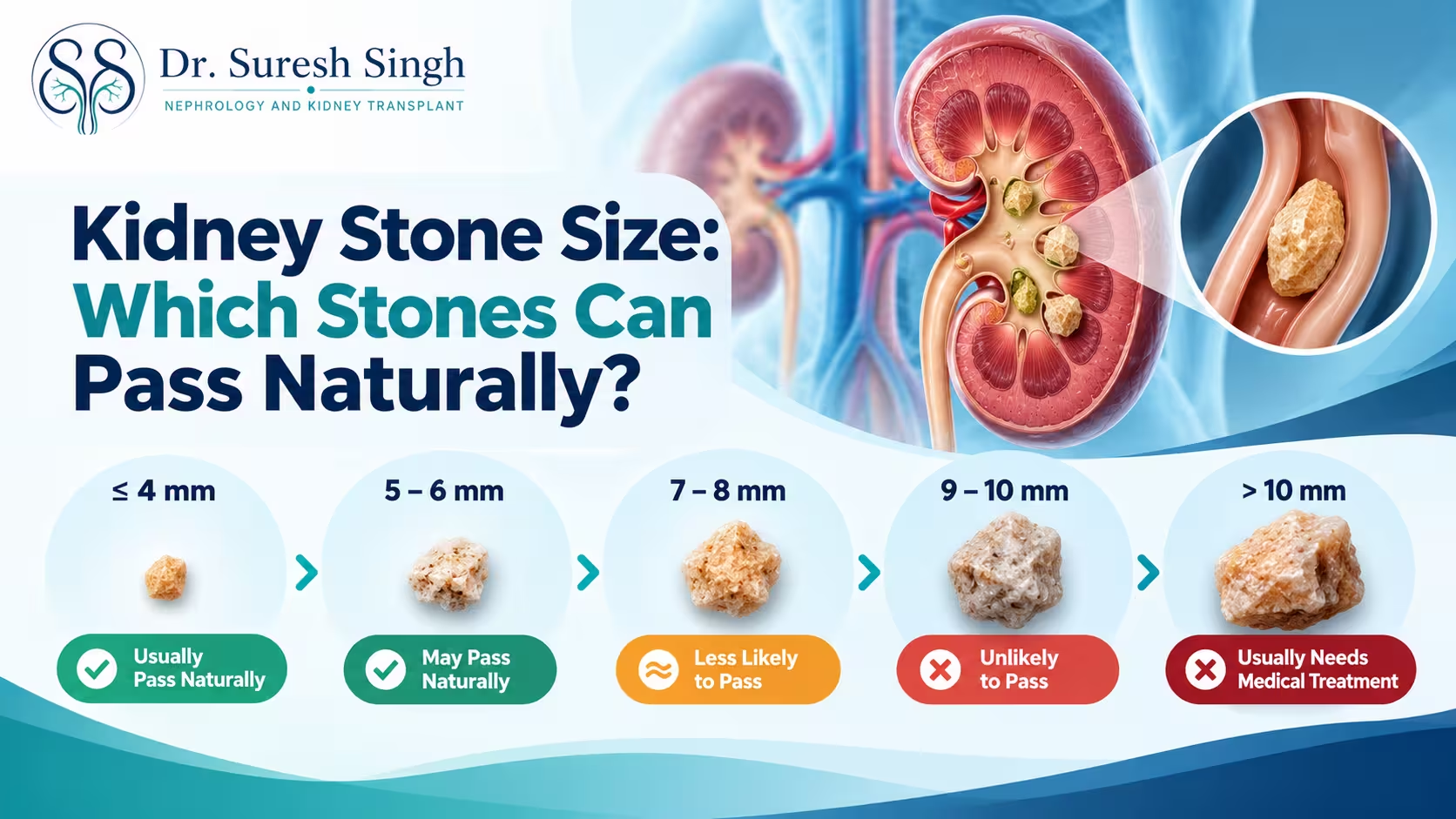
Stones measuring 4 mm or smaller have the highest chance of passing naturally through the urinary tract, while stones larger than 7–10 mm typically require medical intervention.
Which Kidney Stone Sizes Can Pass Naturally?
A stone measuring 2 or 3 mm has a good chance of passing on its own. As the size increases, passing it becomes harder.
Here is a simple guide.
|
Stone Size |
Can It Pass Naturally? |
|
1–2 mm |
Most stones this small pass on their own |
|
3–4 mm |
Many pass without a procedure |
|
5–6 mm |
Some pass, but it may take longer |
|
7–9 mm |
Passing becomes more difficult |
|
10 mm or larger |
A procedure is often needed |
These are general estimates, not a guarantee. A 5 mm stone may pass in one person but get stuck in another. The stone's location and whether it blocks urine flow also matter.
Does a Small Kidney Stone Always Pass on Its Own?
No. Small stones may have a greater likelihood of passing, but they may get stuck along the way.
A stone in the kidney has to travel through a very narrow tube called the ureter to reach the bladder. While on the journey, if the stone gets stuck at any point, it can cause a sharp pain in the back or side. The pain may move towards the lower part of the abdomen or to the groin.
Small stones may pass on their own, but large ones may cause repeated pain. Depending upon your symptoms and the report, stones may be treated.
How Long Does It Take for a Kidney Stone to Pass?
There is no specific duration. One stone may exit the body within a few days, whereas another stone can take several weeks. Certain stones cannot pass by themselves.
The pain can be intermittent due to the passing of the stone. In some cases, there is an abrupt relief from the pain. However, this does not necessarily mean that the stone has exited the body.
Should your physician suggest that you await the passing of the stone, stick to the prescribed schedule of follow-ups. A re-scan may have to be done to confirm whether the stone has been passed.
What Makes a Kidney Stone Harder to Pass?
Two people can have stones of the same size but very different experiences. A few things can explain this.
-
Where the stone is stuck: Stones that are stuck near the bladder have a higher chance of passing compared to stones that are still near the kidney.
-
Size of the stone: Smaller stones have a higher chance of passing compared to larger stones.
-
Blockage in the urine passage: If a stone obstructs the flow of urine, then the kidney will start to swell. This requires medical attention if the blockage doesn’t get resolved.
-
Your kidney health: People with one working kidney or other problems with their kidneys may need to be treated more quickly. Waiting may not be safe for everyone.
Can Medicines Help a Kidney Stone Pass?
Yes, some medicines can work in certain situations. For example, your doctor might prescribe a medicine like tamsulosin to help relax the muscles in the ureter. This can help small stones, especially stones in the lower parts of the urinary tract, pass.
Also, pain medicine might be needed. The right kind of pain medicine for you depends on your kidney function and other health conditions, so don’t take pain medicine regularly without talking to your doctor first.
Always drink enough water to avoid getting dehydrated, unless your doctor has told you not to. Drinking too much water will not make a stone that is stuck come out.
Medicine will not work for all stones. If the stone is very large or continues to block the urine, a procedure may be needed.
When Is a Procedure Needed for a Kidney Stone?
If a kidney stone is too big to pass or is causing a blockage and severe pain, a doctor may suggest a surgical procedure to remove it or to break it up into smaller pieces.
The treatment choice depends on factors like the size of the stone and where it is located.
-
Shock Wave Lithotripsy (SWL): For this procedure, shock waves are aimed at the stone to break it into smaller pieces. The smaller pieces can then be passed through the urine.
-
Ureteroscopy (URS): In this procedure, a thin instrument is passed through the urinary tract to reach the obstructing stone. A laser can be used to break the stone into smaller pieces, or the stone can be removed.
-
Percutaneous Nephrolithotomy (PCNL): This is usually done for large kidney stones. A small incision is made through the back to remove the kidney stone.
Surgery is not always needed. Smaller stones can often be passed naturally. The doctor may recommend waiting and checking the status of the stones to see if they are passed naturally, if there is normal flow of urine, and no other issues.
When Should You Not Wait for a Kidney Stone to Pass?
Some symptoms mean you should get medical help without delay.
-
Fever or chills along with kidney stone pain.
-
Severe pain that does not settle with prescribed medicine.
-
Repeated vomiting that makes it difficult to keep fluids down.
-
Very little urine or no urine at all.
-
Increasing swelling or feeling seriously unwell.
A kidney stone that blocks urine flow and causes an infection can become dangerous. It may need urgent treatment. Do not wait for the stone to pass naturally if these warning signs appear.
Also, do not assume the stone is gone just because the pain has stopped. Your doctor may need to confirm this with a scan or another test.
Personalised Kidney Care With Dr. Suresh Singh
Dr. Suresh Singh, a nephrologist in Lucknow, has over 5 years of nephrology experience and has performed more than 50 kidney transplants and 200 kidney biopsies, according to his published professional profile. His expertise includes kidney disease management, glomerular diseases, dialysis, and interventional nephrology. Patients with recurrent kidney stones or concerns about kidney function can seek an assessment of their kidney health and associated risk factors, along with guidance on appropriate investigations, prevention, and referral for stone-removal procedures when needed.
Related Treatments
Depending on your diagnosis and clinical needs, the following kidney-care services may be relevant:
Conclusion
Not all kidney stones follow the same path. The average size of a stone that can be naturally passed is 5 mm. Larger stones can take months to pass. If a stone is bigger, it can be blocked and will require some treatment. Your doctor can tell you if waiting on treatment is a good idea based on your scan.
Dr. Suresh Singh is a Consultant Nephrologist and Kidney Transplant Physician in Lucknow with 5+ years of experience in the management of patients with chronic kidney disease, end-stage renal disease, renal replacement therapies (dialysis and transplantation), and broad experience in advanced kidney care. For a kidney stone, it is prudent to take a second opinion from a urologist regarding the passage of the stone or its further management.
Frequently Asked Questions
1. How will I know if my stone has passed?
It is possible that sometimes one can actually observe the stone passing out of his or her body in the urine. However, the doctor might have to perform further tests to determine whether this is true.
2. Can a kidney stone recur even after having been treated?
Yes, indeed. The removal of the stone does not prevent future formation of stones. Depending on the kind of stone, the doctor might ask for further tests to understand its cause.
3. Does every kidney stone lead to blood in the urine?
No, it is not always like this. Sometimes the stone leads to blood in the urine, and it becomes red or pink. However, some stones do not lead to the appearance of any signs at all.
4. Do children have kidney stones?
Yes. Kids are also prone to developing kidney stones. When kids experience severe pain on the sides or the back, blood in their urine, or difficulty urinating, a visit to the doctor is recommended.
5. Will a kidney stone hurt my kidney?
Yes. The risk is high, especially when the kidney stone prevents the flow of urine for a long time and causes an infection.